

Tokenomics
STABLE is the governance token of the Stable Mainnet. It secures the network through delegated Proof-of-Stake, governs protocol upgrades, and entitles stakers to a share of USDT0 gas revenue distributed by validators.
Overview
| Item | Details |
|---|---|
| Symbol | STABLE |
| Total supply | 100,000,000,000 tokens |
| Standard | ERC-20 (on Stable Mainnet EVM) |
| Decimals | 18 |
STABLE is the governance token of the Stable Mainnet and Ecosystem, designed to support long-term economic alignment across validators, developers, and users.
Token allocation
Total supply: 100,000,000,000 STABLE tokens
| Category | Allocation | Amount of STABLE |
|---|---|---|
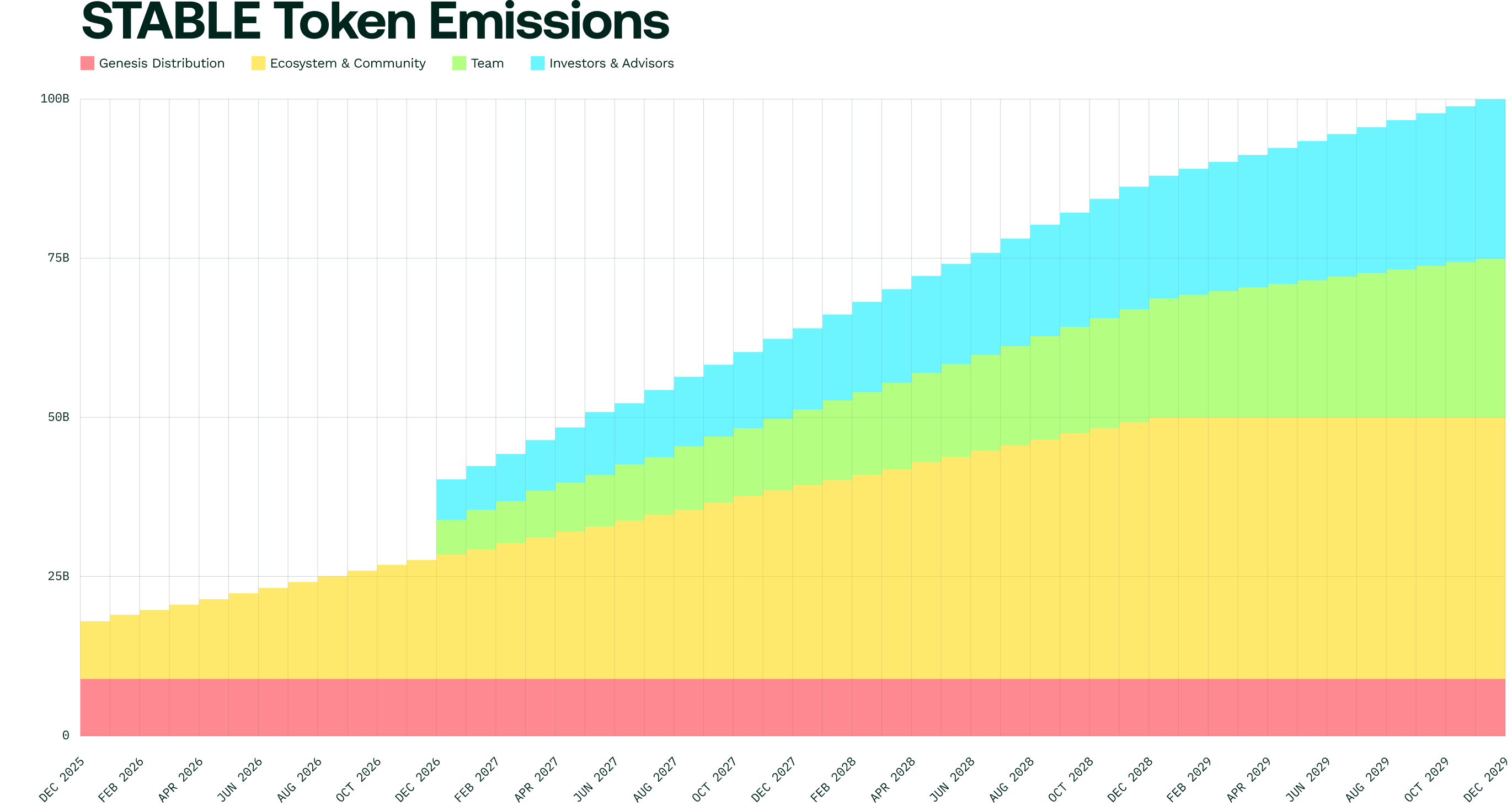
| Investors & advisors | 25% | 25,000,000,000 |
| Team | 25% | 25,000,000,000 |
| Ecosystem & community | 40% | 40,000,000,000 |
| Genesis distribution | 10% | 10,000,000,000 |
| Total | 100% | 100,000,000,000 |
Emission model & supply schedule
- Total supply is fixed at 100,000,000,000 STABLE tokens.
- Only a portion of supply enters circulation at launch of the Stable Mainnet.
- Team and Investors & advisors allocations follow a 4-year linear vesting model, with a 1-year cliff, to ensure long-term commitment.
Allocations
Genesis distribution - 10% of total token supply
-
Designed to bootstrap usage, provide liquidity to market, conduct airdrop events, reward early supporters and campaigns with exchanges and ecosystem partners.
Vesting schedule- 100% unlocked at the Stable Mainnet launch
Ecosystem & community - 40% of total token supply
Supports long-term ecosystem and community growth:
-
Support the development of the Stable software and ecosystem
-
Developer grants
-
User onboarding incentives
-
Payment partner integrations
-
On-chain activity rewards
-
Hackathons, ambassador programs
-
Infrastructure grants
Vesting schedule- Initial unlock: 8% of total supply unlocked at the Stable Mainnet launch. These tokens fund incentives for strategic launch partners, liquidity needs, and early ecosystem growth campaigns.
- Total vesting period: 3-year linear vesting thereafter for the 32% of total supply
Team - 25% of total token supply
-
Allocated to founding team members, engineers, researchers, and contributors
-
Designed to ensure long-term alignment between the team and the Stable ecosystem.
Vesting schedule- 1-year cliff: No tokens are unlocked in the first 12 months
- Total vesting period: 48 months linear vesting from the Stable Mainnet launch
Investors & advisors - 25% of total token supply
-
Allocated for fundraising rounds and advisory support.
Vesting schedule- 1-year cliff: No tokens are unlocked in the first 12 months
- Total vesting period: 48 months linear vesting from the Stable Mainnet launch
Emissions chart
Economic design principles
Stable's token economics were designed around three foundational goals:
1. Power a payments-optimized Layer 1
The STABLE token incentivizes high-throughput, low-latency infrastructure, supporting sub-second block confirmations and enterprise settlement guarantees.
2. Support sustainable ecosystem growth
40% of total token supply is dedicated to long-term growth, focusing on key development and growth areas.
- Developer grants
- Partner integrations
- New ecosystem applications
3. Align long-term contributors via vesting
The team allocation uses a 4-year linear vesting model, with a 1-year cliff, ensuring long-term alignment and continued contributions toward network development.
Utility of the STABLE token
The STABLE Token is an ERC-20 governance token on the Stable Mainnet. It can be used for:
- Electing validators
- Voting on protocol upgrades
- Handling governance proposals
- Serving as a credential to receive gas fee distribution from validators
On the Stable network, all transactions use USDT0 as the native gas token. These USDT0 gas fees are collected into a treasury managed by smart contracts. When token holders stake their STABLE tokens to validators, validators may choose to distribute gas fees from the treasury proportionally to stakers.